Why Your CEO Needs Precedents, Not Opinions
How to use historical data to stop a crisis before it leaves the draft folder.
Spotting a PR risk is usually easy. Convincing a stressed CEO that it matters is the hard part.
This is a story I've heard repeated after conversations with dozens of in-house PR teams. You are the expert. You know instinctively when a statement is going to land wrong. But when you are in the room with a stressed executive, "my gut says no" isn't always enough to win the argument.
You need objective proof. You need to show them that their "authentic" idea has been tried before, and that it failed.
The Scenario:
Imagine a major service outage. The engineering team is exhausted. The CEO wants to send a personal message to customers to show he cares. They draft this:
"We know this service outage has been incredibly disruptive to your business. Our engineering team has been working 24/7 to patch the vulnerability. We are committed to fixing this immediately so you can return to normal operations, and frankly, I'd like my life back as well."
A PR pro reads this and sees a resignation letter.
You know immediately that centering the CEO's inconvenience during a customer crisis is tone-deaf. But in the heat of the moment, telling a CEO "you sound selfish" burns massive political capital.
This is where Precedent Search changes the dynamic. Instead of offering an opinion, you show the data.
The Historical Echo
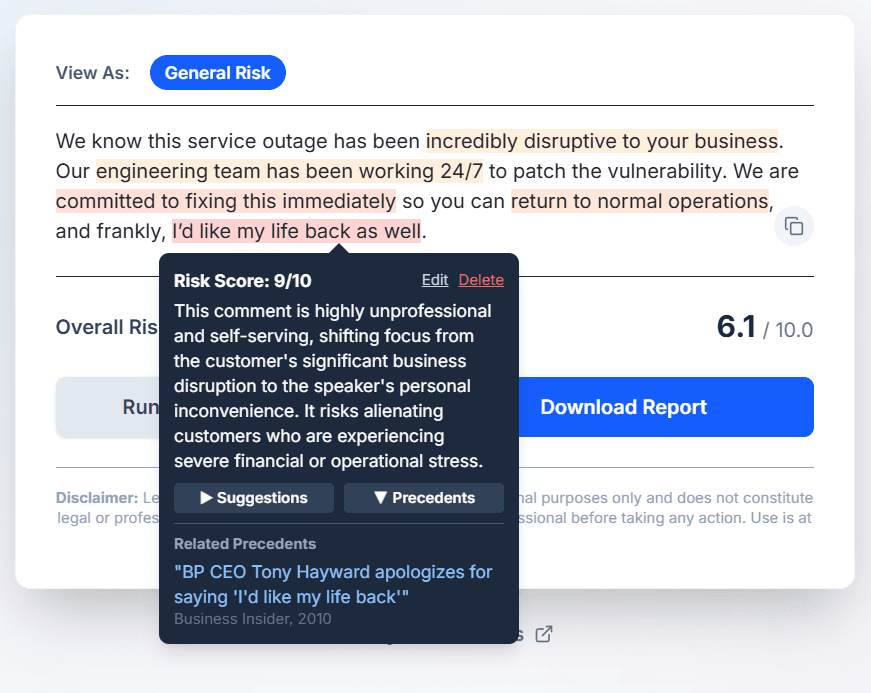
Lexient flags the tone, sure. But more importantly, it catches the historical example.
It instantly identifies that the phrase "I'd like my life back" matches the exact words spoken by BP CEO Tony Hayward during the 2010 Deepwater Horizon oil spill. It's often considered one of the worst PR gaffes in corporate history.
The Takeaway
This stops you from being the "person who kills good ideas" and makes you the person who stops them from becoming a cautionary tale.
Lexient gives you the objective evidence to kill bad ideas in the boardroom without spending your own political capital.
It's hard to argue with feelings. It's impossible to argue with a precedent.